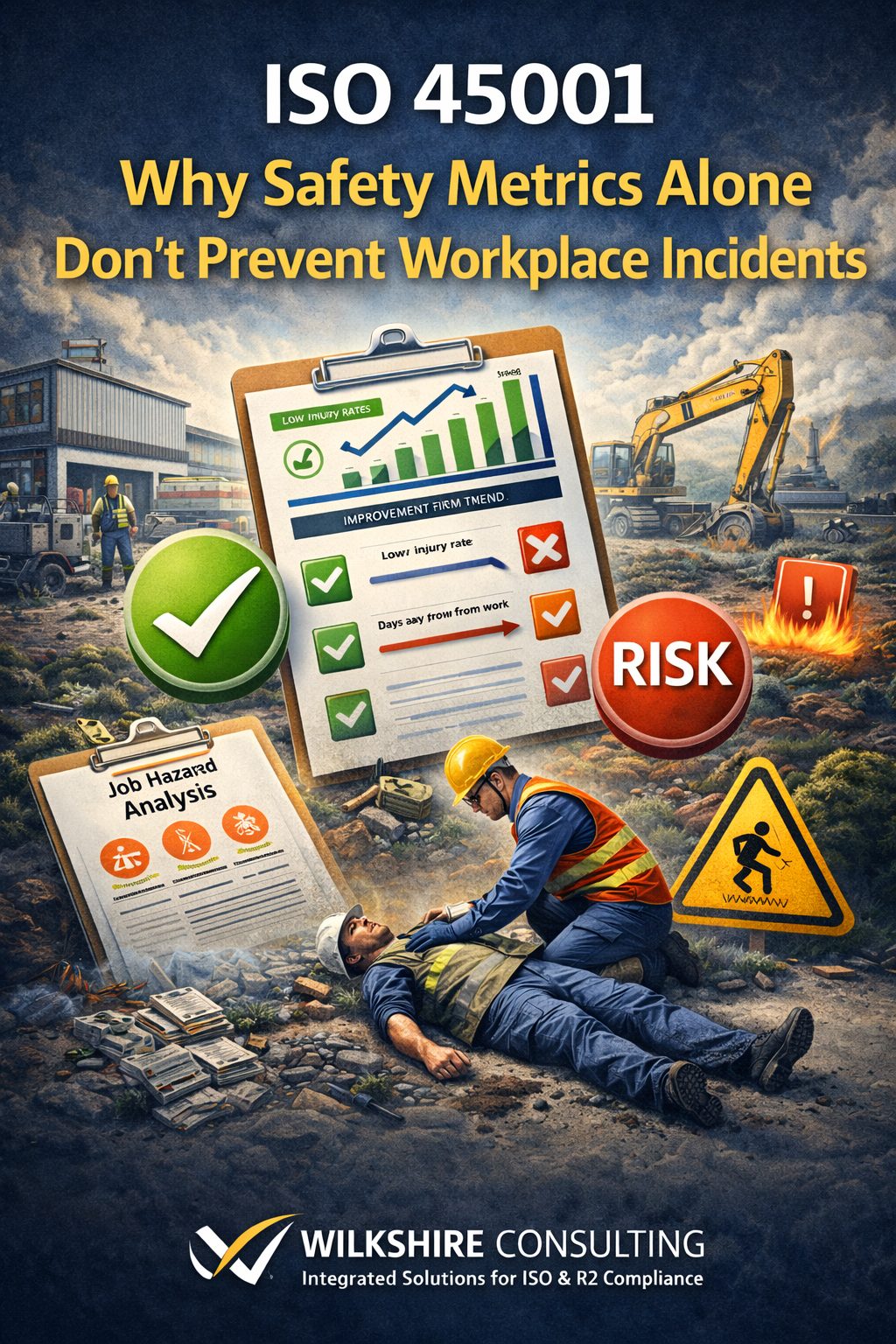
Many organizations believe they have strong safety programs because their numbers look good. Incident rates are low. Lost time injuries are minimal. Reports show improvement year over year.
Yet serious incidents still happen — often without warning.
ISO 45001 was created to address this exact disconnect. The standard recognizes that safety metrics alone do not prevent incidents. True safety performance depends on how risks are identified, controlled, and managed long before an injury occurs.
Organizations that rely solely on lagging indicators often discover too late that their systems were measuring outcomes, not preventing failures.
The Problem with Lagging Safety Indicators
Lagging indicators — such as injury rates, recordable incidents, and days away from work — measure what has already happened. While these metrics are useful for reporting, they provide limited insight into current risk exposure.
Common limitations include:
- They don’t capture near-misses or unsafe conditions
- They improve after incidents occur, not before
- They can create a false sense of security
An organization can go months or years without a serious incident while underlying hazards remain unaddressed.
ISO 45001 shifts the focus from outcomes to risk control effectiveness.
Safety Is a System, Not a Statistic
ISO 45001 emphasizes that workplace safety is the result of a functioning management system, not isolated safety rules or training sessions.
Effective safety systems include:
- Hazard identification that reflects real work conditions
- Risk assessments that prioritize severity and exposure
- Controls that are practical, enforced, and reviewed
- Worker participation in identifying and managing risks
When these elements are weak, metrics improve temporarily — until they don’t.
Why Job Hazard Analysis Often Falls Short
Job Hazard Analysis (JHA) is a core element of ISO 45001, yet it is frequently treated as a one-time exercise.
Common mistakes include:
- Generic hazard lists copied across job roles
- JHAs that don’t reflect actual task variability
- Lack of worker input
- No link between JHAs and operational controls
ISO 45001 requires hazard identification to be ongoing and dynamic, accounting for changes in equipment, processes, staffing, and environment.
Learn more about ISO 14001 and why it isn’t Just Environmental Compliance - Blog
ISO 14001 Isn’t Just Environmental Compliance — It’s Risk Management
Worker Participation Is Not Optional
One of the most critical — and most audited — requirements of ISO 45001 is worker participation.
Auditors routinely look for evidence that:
- Workers are involved in hazard identification
- Safety concerns are reported without fear of retaliation
- Feedback leads to corrective action
Organizations that exclude workers from safety decision-making often miss the hazards that matter most. Frontline employees understand risks that never appear in procedures or reports.
The Hidden Cost of Reactive Safety Management
Reactive safety management focuses on responding to incidents rather than preventing them. This approach almost always costs more in the long run.
Hidden costs include:
- Production downtime
- Overtime and retraining
- Increased insurance premiums
- Regulatory scrutiny
- Reduced employee trust
ISO 45001 is designed to prevent these costs by embedding safety controls into everyday operations.
Safety Leadership Drives Real Results
ISO 45001 places explicit responsibility on leadership for safety performance. This requirement is not symbolic — it is foundational.
Effective safety leadership includes:
- Setting clear safety expectations
- Allocating resources to risk control
- Holding management accountable for safety outcomes
- Reviewing safety performance as part of business strategy
When leadership treats safety as a core value rather than a compliance obligation, safety systems become far more effective.
Find out What Auditors Actually Want to See in this blog:
ISO 9001 Management Review: What Auditors Actually Want to See
Integration Strengthens Safety Outcomes
Safety risks intersect with:
- Quality failures (ISO 9001)
- Environmental incidents (ISO 14001)
- Data security and downstream risks (R2v3)
An integrated management system ensures safety considerations are part of operational planning, change management, and corrective action processes.
This integration reduces conflicting priorities and ensures safety is not compromised in the pursuit of productivity.
Auditors Look Beyond Numbers
ISO 45001 auditors do not rely solely on incident statistics.
They evaluate whether:
- Hazards are identified proactively
- Controls are implemented and effective
- Workers understand safety expectations
- Leadership is engaged
Organizations that focus only on metrics often struggle during audits because the underlying system lacks depth.
How Wilkshire Consulting Helps Organizations Prevent Incidents
At Wilkshire Consulting, we help organizations implement ISO 45001 as a risk-based safety management system, not a reporting framework.
Our approach focuses on:
- Identifying real-world safety risks
- Strengthening hazard controls
- Improving worker engagement
- Integrating safety with quality, environmental, and R2v3 systems
The result is a safety system that reduces incidents, improves culture, and supports long-term operational stability.