When most business owners picture the cost of non-compliance, they picture a fine. A number on a letter from a regulator. Pay it, move on, tighten things up. But the fine is almost always the smallest part of the bill — and treating it as the whole story is exactly how compliance gets deprioritized until it becomes an expensive problem.
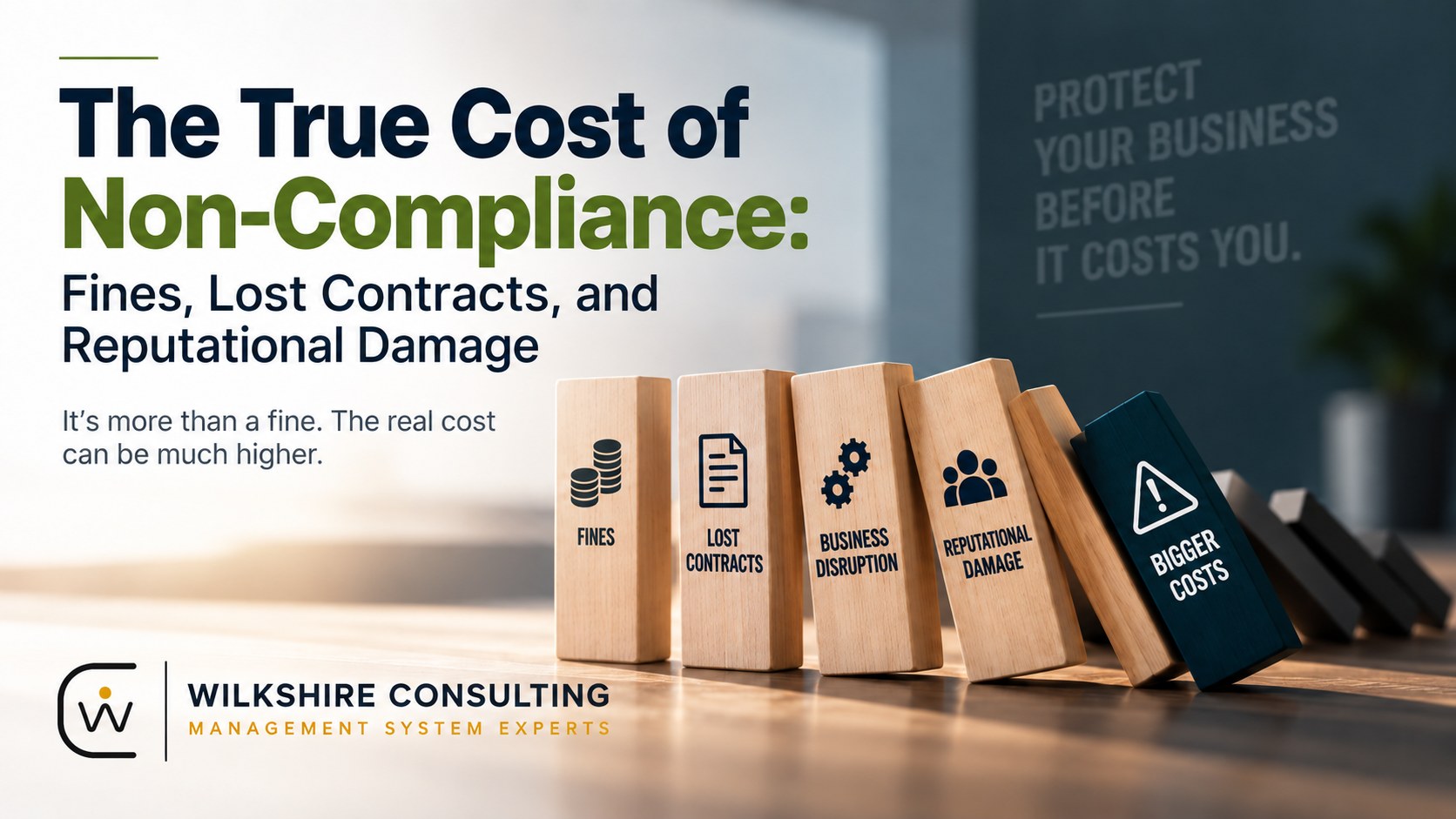
The research is blunt about this. In the most widely cited study on the subject, the average cost of non-compliance came in at $14.82 million, versus $5.47 million to maintain compliance — meaning non-compliance costs organizations roughly 2.7 times more than staying compliant. And here’s the part that should reframe how you think about it: of that $14.82 million, fines, penalties, and settlements accounted for less than $2 million. The other roughly $12.87 million came from business disruption, lost revenue, and lost productivity. The fine was barely a tenth of the damage.
Let’s walk through where the real money goes.
Cost #1: The Fine (The Part Everyone Sees)
Fines are real, and depending on your industry they can be severe. GDPR violations can reach €20 million or 4% of annual worldwide turnover, whichever is higher. HIPAA’s highest civil penalty tier in 2026 can reach over $2.1 million per violation depending on culpability. For defense contractors, False Claims Act penalties tied to cybersecurity requirements can hit $250,000 per violation. Across the board, regulatory enforcement is intensifying, not easing — GDPR enforcement alone has now crossed €6 billion in cumulative fines across more than 3,000 actions.
But notice something about all of those: they’re the entry cost. The number on the letter. If your risk assessment stops there, you’re underpricing the actual exposure by an order of magnitude.
Cost #2: The Contract You Lose (Often the Real Killer)
For most of the businesses we work with, this is the one that actually hurts. Increasingly, compliance isn’t just a regulatory obligation — it’s a commercial one. Enterprise clients, government agencies, and large manufacturers routinely require certifications and compliance standards as a condition of even being considered as a vendor. No certificate, no bid.
Consider what happened to Health Net Federal Services, a military health benefits administrator. It paid $11.2 million to settle allegations that it falsely certified compliance with cybersecurity requirements in a Department of Defense contract. But the settlement wasn’t the end of it — the company also lost the contract, compounding the loss of revenue on top of the penalty. Two hits from one failure: the fine, and then the far larger loss of the business that failure disqualified them from keeping.
This is the mechanism that quietly drains growing companies. You don’t get a letter. You just stop making shortlists. The RFP lists a certification you don’t hold as “required” or “preferred,” and you’re screened out before anyone reads your proposal. You never see the revenue you didn’t win, so it never shows up as a cost — but it’s real, and for a company trying to move upmarket, it can be the difference between the tier of business you’re stuck in and the one you’re trying to reach.
Cost #3: Business Disruption
When a compliance failure surfaces, work stops. You’re pulling people off their actual jobs to investigate what went wrong, document it, remediate it, and prove to someone that it won’t happen again. Estimates put the average cost of business disruption from non-compliance at over $5 million — and in one industry poll, a third of respondents reported they’d experienced business disruption as a direct result of non-compliance.
In regulated product industries the disruption cost dwarfs the fine entirely. A recall or a regulatory delay — say a 16-month hold on a product launch — can wipe out $50 to $70 million in sales through operational disruption alone, not penalties. The fine is a rounding error next to the revenue you couldn’t earn while everything was frozen.
Cost #4: Reputational and Market-Value Damage
This is the cost that’s hardest to put on an invoice and often the largest of all. When word gets out that an organization cut corners, customers leave — and they don’t leave quietly. One analysis found that lost business due to downtime or diminished reputation accounts for 38% of the total cost of a data breach.
But the most striking finding comes from research into how markets react to regulatory sanctions. A study by Armour, Mayer, and Polo found that the stock-price impact of regulatory sanctions was, on average, ten times larger than the financial penalties themselves. In other words: for every $1 in fines, companies averaged $10 in reputational and market-value losses. The fine is the visible tip; the market punishes the underlying failure roughly ten times harder.
You don’t have to be publicly traded for this to apply. The same dynamic plays out privately as lost customers, harder sales conversations, nervous partners, and the slow erosion of the trust that made people want to work with you in the first place. Trust is expensive to build and cheap to destroy, and once it’s gone the cost of rebuilding it rarely fits on a spreadsheet.
Cost #5: The Cascade Nobody Budgets For
The costs above don’t politely wait in line — they compound. A single missed requirement can trigger a fine, an audit, a lost contract, operational delays, and executive scrutiny within the same quarter. Insurance amplifies it further: premiums rise after violations, claims get denied, and many policies specifically exclude regulatory fines and recall-related losses, leaving you to absorb them directly.
There’s also an opportunity cost most businesses never count. Research suggests that a meaningful share of companies — around a third in one study — miss profitable business opportunities specifically because of compliance gaps. Not because they were fined, but because they simply couldn’t pursue the work.
Why “We’ll Deal With It If It Happens” Is the Expensive Choice
Put the numbers side by side and the logic is hard to argue with. Compliance averages $5.47 million; non-compliance averages $14.82 million. The gap has been widening for over a decade — non-compliance costs rose roughly 45% across the period studied, outpacing the rise in compliance costs. Whatever it costs to do this right, doing it wrong has consistently cost more, and the spread is growing.
The reason it doesn’t feel that way in the moment is that compliance costs are visible and immediate — you write the check for the audit, the consultant, the training — while non-compliance costs are deferred, probabilistic, and scattered across categories that don’t announce themselves as “the cost of skipping this.” The fine is obvious. The contract you never won, the customer who quietly left, the deal you weren’t eligible for, the market value that eroded — those don’t send invoices. But they add up to the overwhelming majority of the real bill.
What This Means for Your Business
You don’t need to be a Fortune 500 company staring down a GDPR case for any of this to apply. Scaled down, the same structure holds for a mid-sized manufacturer, an ITAD provider, or any business whose customers increasingly ask “are you certified?” before they ask “what’s your price?”
The practical takeaway isn’t fear — it’s reframing. Compliance and certification aren’t a cost center you’re trying to minimize. They’re the thing standing between you and the fines, the lost contracts, the disruption, and the reputational hits that cost multiples more. Framed that way, a management system that keeps you compliant isn’t an expense. It’s one of the better-returning investments on your books — you just don’t see the return, because the return is all the expensive things that didn’t happen.
Quick answers
What’s the average cost of non-compliance? The most widely cited figure is $14.82 million, versus $5.47 million to maintain compliance — roughly 2.7 times more expensive to be non-compliant than compliant.
Isn’t the fine the main cost? No. In the same research, fines and penalties made up under $2 million of that $14.82 million average. The bulk came from business disruption, lost revenue, and lost productivity.
How does non-compliance affect reputation? Significantly. One analysis found reputational and market-value losses averaged about 10 times the size of the fines themselves, and lost business accounts for a large share of total breach costs.
Can non-compliance cost me contracts? Yes — often the biggest hit. Many enterprise and government clients require compliance certifications as a condition of being a vendor, so gaps can disqualify you from work entirely, sometimes without you ever knowing why.
Not sure where your compliance gaps actually are — or what they might be quietly costing you? Book a free compliance risk review and we’ll help you find them before they find you.