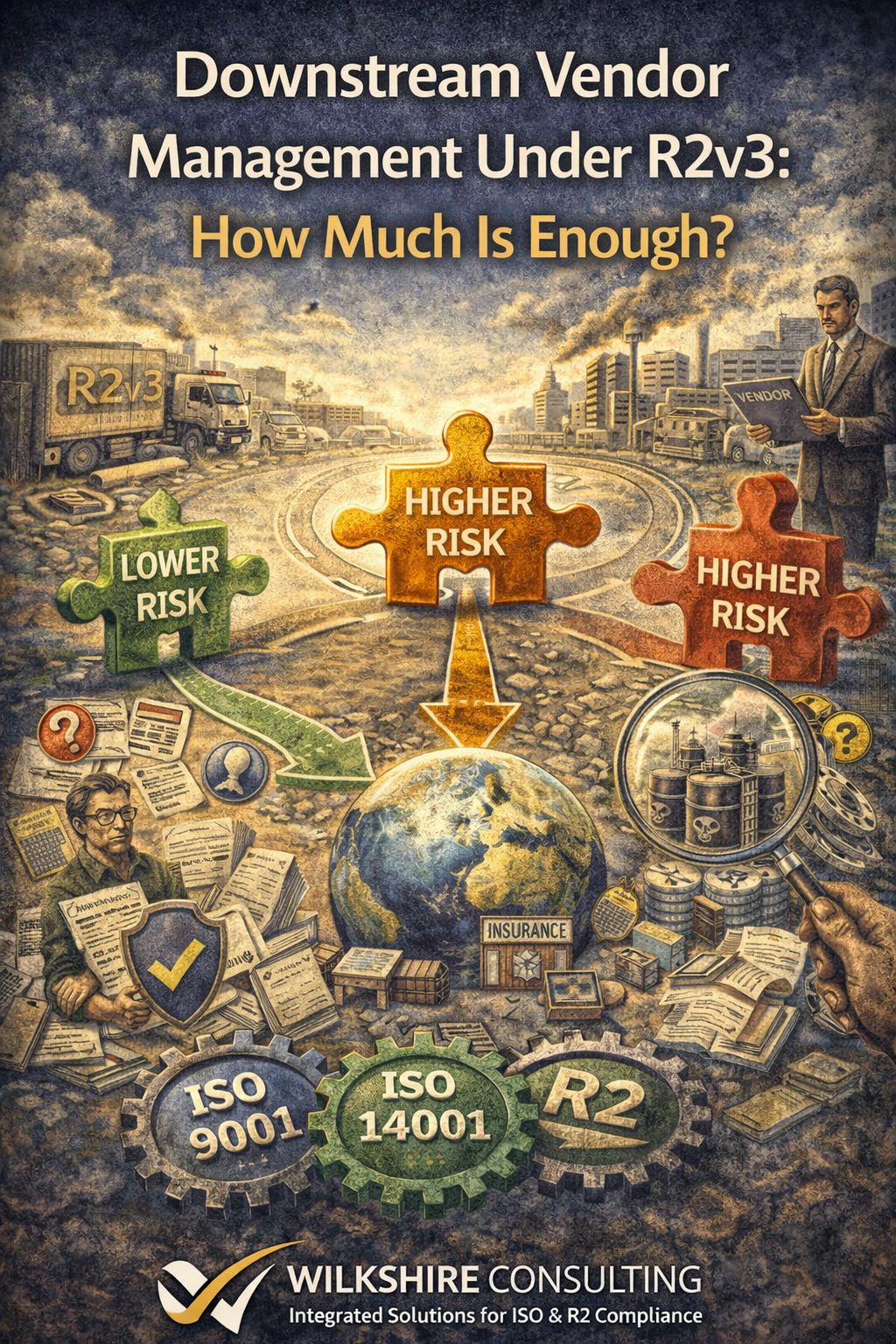
Downstream vendor management is one of the most critical — and most scrutinized — components of R2v3 Responsible Recycling.
It is also one of the areas where organizations struggle most.
Many recyclers understand that they are responsible for their downstream vendors. What is less clear is how much control is enough to satisfy auditors, customers, and regulators without overburdening operations.
Some organizations overcomplicate downstream management with excessive documentation and unrealistic oversight expectations. Others take a minimal approach, leaving gaps that can lead to audit findings or, worse, reputational risk.
R2v3 requires a balanced approach — one that is both defensible and practical.
Why Downstream Management Matters More Than Ever
Under R2v3, your responsibility does not end when material leaves your facility.
Organizations are accountable for ensuring that downstream vendors:
- Handle materials responsibly
- Comply with environmental and legal requirements
- Protect data where applicable
- Do not introduce reputational or regulatory risk
In today’s market, customers are increasingly aware of downstream risk. Many conduct their own due diligence and expect recyclers to demonstrate full control of their material streams.
Weak downstream oversight can quickly undermine an otherwise strong R2 system.
What R2v3 Actually Requires
R2v3 requires organizations to:
- Identify all downstream vendors
- Evaluate and qualify those vendors
- Assess risks associated with downstream activities
- Maintain documentation of due diligence
- Monitor vendor performance over time
The intent is clear: organizations must have visibility and control over what happens to materials beyond their facility.
However, the standard does not prescribe exactly how this must be done — leaving room for interpretation.
Interested in learning more about ISO & R2 integrated systems? Check out the blog below:
How Integrated ISO & R2 Systems Reduce Audit Costs and Improve Client Trust
Where Organizations Get It Wrong
Over-Reliance on Paperwork
Some organizations believe that collecting certifications, insurance documents, and contracts is sufficient.
While documentation is important, it does not replace actual risk evaluation.
Auditors often look for evidence that organizations understand:
- What each vendor actually does
- What risks are associated with those activities
- How those risks are controlled
Paperwork alone does not demonstrate this understanding.
Treating All Vendors the Same
Not all downstream vendors carry the same level of risk.
For example:
- A vendor handling non-hazardous commodities presents a different risk profile than one processing hazardous materials
- A domestic partner may be easier to verify than an international one
Applying identical oversight requirements to all vendors can either:
- Overcomplicate low-risk relationships
- Under-control high-risk ones
Effective systems use risk-based segmentation.
Lack of Ongoing Monitoring
Qualification is only the first step. Vendors must be monitored over time.
Common gaps include:
- No periodic review of vendor performance
- Failure to track changes in vendor operations
- Lack of requalification processes
R2v3 expects organizations to maintain ongoing oversight, not just initial approval.
Weak Documentation of Decisions
Organizations often perform informal evaluations but fail to document their reasoning.
During audits, this creates challenges.
Auditors want to see:
- How risks were assessed
- Why vendors were approved
- What controls are in place
If decisions are not documented, they cannot be verified.
A Risk-Based Approach Works Best
The most effective downstream management systems are built on risk-based thinking.
This involves:
Categorizing Vendors by Risk Level
High-risk vendors may include:
- Hazardous material processors
- International downstream partners
- Vendors without certifications
Lower-risk vendors may include:
- Domestic commodity buyers
- Certified processors with established track records
This categorization allows organizations to focus resources where they are most needed.
Defining Appropriate Controls
Controls should match the level of risk.
Examples include:
- On-site audits for high-risk vendors
- Periodic document reviews for lower-risk vendors
- Performance tracking metrics
- Clear contractual requirements
This ensures that oversight is both effective and efficient.
Maintaining Clear Records
Documentation should demonstrate:
- Vendor qualification
- Risk evaluation
- Monitoring activities
- Corrective actions when needed
Well-organized records simplify audits and improve internal visibility.
Interested in learning more about EHS under the R2v3 certification? Check out this blog:
Environmental, Health, and Safety (EHS) Management Under R2v3: Protecting Workers and the Planet
Integration Strengthens Downstream Oversight
Downstream vendor management intersects with other management systems.
For example:
- Environmental risks align with ISO 14001
- Safety considerations align with ISO 45001
- Process controls align with ISO 9001
Organizations with integrated systems can leverage existing processes such as:
- Supplier evaluation programs
- Corrective action systems
- Internal audits
This reduces duplication and improves consistency.
Auditors Focus on Understanding and Control
During R2v3 audits, certification bodies often ask:
- Do you know where your materials go?
- Do you understand what your vendors do?
- How do you know they are performing responsibly?
- What happens if a vendor fails to meet expectations?
Organizations that can answer these questions clearly — with supporting evidence — demonstrate strong system maturity.
The Goal Is Control, Not Perfection
No system can eliminate all downstream risk.
The objective of R2v3 is to ensure that organizations:
- Understand their risks
- Implement reasonable controls
- Monitor performance
- Take action when necessary
Overcomplicating the system can make it difficult to maintain. Oversimplifying it can leave critical gaps.
Balance is key.
How Wilkshire Consulting Helps Strengthen Downstream Systems
At Wilkshire Consulting, we help recyclers and ITADs build downstream vendor management systems that are both audit-ready and operationally practical.
Our approach focuses on:
- Risk-based vendor segmentation
- Defensible qualification processes
- Clear and maintainable documentation
- Integration with ISO and R2 systems
- Ongoing monitoring frameworks
The result is a downstream management system that protects your organization, satisfies auditors, and builds customer confidence.
Because in R2v3, your reputation depends not just on what you do — but on what happens after your material leaves your control.