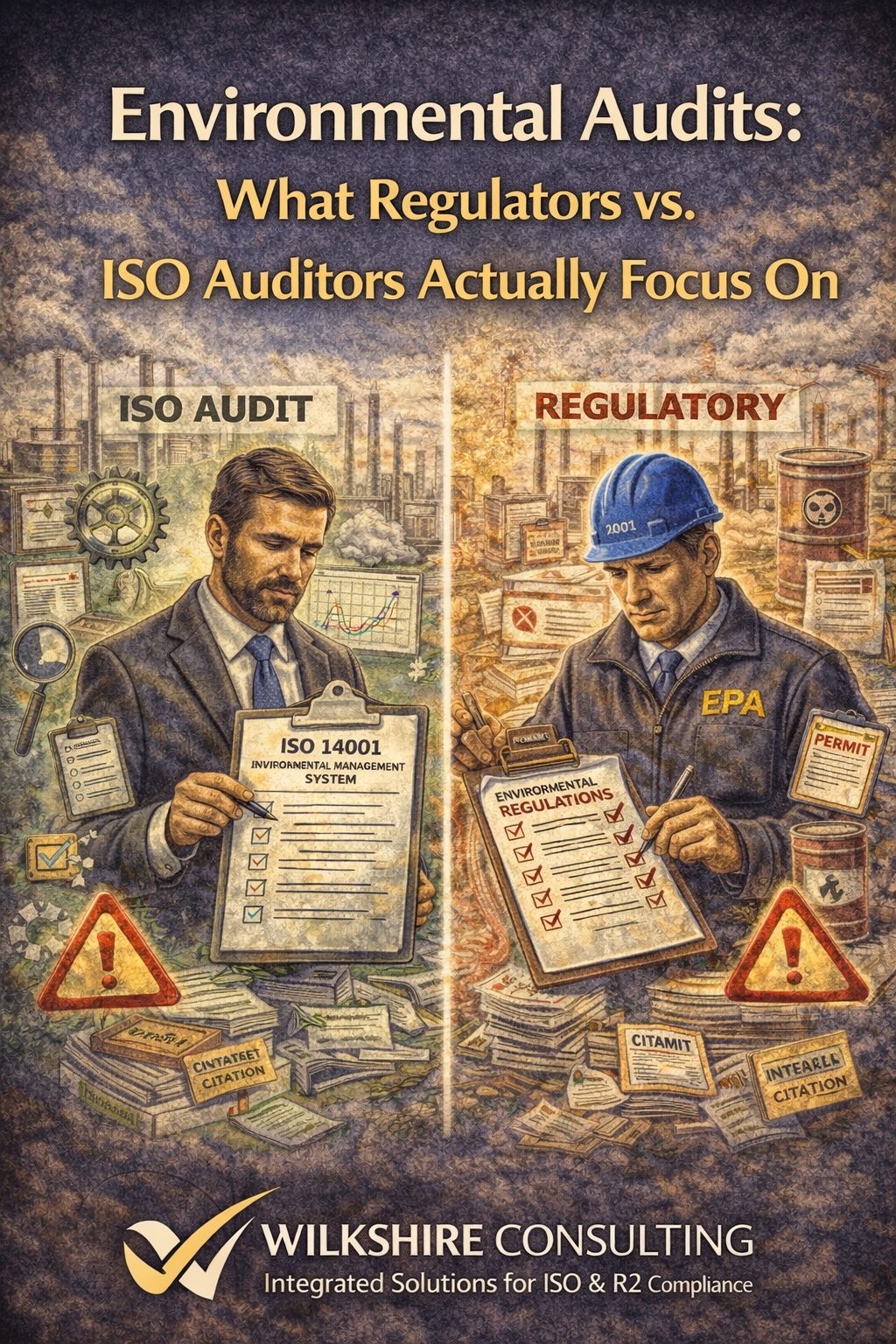
Many organizations assume that ISO 14001 certification means they are fully prepared for environmental audits.
In reality, ISO audits and regulatory inspections are very different — and confusing the two can create serious risk.
ISO 14001 focuses on whether your management system is effective.
Regulatory agencies focus on whether you are in compliance with the law.
Both matter. But they evaluate your organization in very different ways.
Understanding these differences is critical for avoiding fines, failed inspections, and reputational damage.
ISO 14001 Audits Focus on Systems
ISO 14001 auditors are not enforcing environmental law. They are evaluating whether your environmental management system (EMS) is functioning effectively.
They want to see that you:
- Identify environmental aspects and impacts
- Evaluate environmental risks
- Implement operational controls
- Monitor performance
- Maintain compliance obligations
- Continually improve
In short, ISO auditors are asking:
Do you have a system that can manage environmental risk consistently?
They are not typically verifying every regulatory detail — they are verifying that your system is capable of doing so.
Regulatory Audits Focus on Compliance
Regulatory agencies (EPA, state agencies, etc.) take a very different approach.
They are not evaluating your system — they are evaluating your actual compliance status.
They want to know:
- Are you following permit requirements?
- Are waste streams properly managed?
- Are emissions within legal limits?
- Are records accurate and complete?
- Are reports submitted on time?
Their question is simple:
Are you compliant right now?
If the answer is no, there can be immediate consequences — including fines, citations, or operational restrictions.
Do you need to know what is coming on the new ISO 9001:2026 revision? Read below:
ISO 9001:2026 Is Coming – What Businesses Need to Know Now
Why Organizations Get Caught Off Guard
One of the most common mistakes organizations make is assuming:
“We passed our ISO audit, so we must be compliant.”
This assumption creates risk.
Here’s why:
- ISO audits may sample records — regulators may review everything
- ISO auditors assess systems — regulators enforce laws
- ISO findings are corrective — regulatory findings can be punitive
An organization can pass an ISO 14001 audit and still fail a regulatory inspection.
Key Differences in Audit Approach
1. Depth vs. Structure
ISO auditors:
- Follow processes
- Sample records
- Evaluate consistency
Regulators:
- Dive deep into specific compliance areas
- Focus on detailed requirements
- Verify exact adherence to regulations
2. Flexibility vs. Strict Enforcement
ISO 14001 allows flexibility in how systems are designed.
Regulations do not.
For example:
- ISO allows you to define your own aspect evaluation method
- Regulations define exactly how waste must be handled
3. System Effectiveness vs. Legal Compliance
ISO auditors may accept minor gaps if the system is functioning overall.
Regulators typically do not.
A single missed report or improperly labeled container can result in a violation.
4. Corrective vs. Consequence-Based Outcomes
ISO audit findings:
- Require corrective action
- Focus on improvement
Regulatory findings:
- May result in fines
- Can trigger enforcement actions
- May require immediate remediation
Where the Two Overlap
Despite their differences, ISO 14001 and regulatory compliance are closely connected.
A strong environmental management system should:
- Track compliance obligations
- Monitor regulatory requirements
- Ensure controls are implemented
- Identify noncompliance quickly
ISO 14001 is designed to support compliance — but it does not replace it.
Organizations that integrate compliance into their EMS are far better prepared for both types of audits.
Interested in learning more about ISO & R2 integrated systems? Check out the blog below:
How Integrated ISO & R2 Systems Reduce Audit Costs and Improve Client Trust
The Biggest Risk: False Confidence
The most dangerous situation is when organizations develop false confidence in their environmental performance.
This often happens when:
- ISO audits go smoothly
- Documentation looks strong
- Systems appear well-organized
But:
- Compliance obligations are not actively tracked
- Operational controls are inconsistently applied
- Regulatory details are overlooked
This gap is where regulatory violations occur.
How to Prepare for Both Types of Audits
Organizations that succeed in both ISO and regulatory audits focus on alignment.
1. Link Compliance Obligations to Operations
Don’t just document regulations — connect them to:
- Procedures
- Work instructions
- Daily activities
2. Maintain Accurate and Complete Records
Regulators rely heavily on documentation.
Ensure:
- Logs are complete
- Reports are accurate
- Records are easily accessible
3. Conduct Compliance-Focused Internal Audits
Internal audits should go beyond ISO requirements and include:
- Permit reviews
- Waste handling verification
- Record accuracy checks
4. Train Employees on Real Requirements
Employees should understand:
- What regulations apply
- Why controls exist
- What happens if controls fail
5. Regularly Review Regulatory Changes
Regulations change frequently.
Organizations must:
- Stay current
- Update procedures
- Communicate changes internally
Integration Is the Advantage
Organizations that integrate ISO 14001 with:
- ISO 9001 (process control)
- ISO 45001 (safety)
- R2v3 (downstream/environmental responsibility)
…are better positioned to manage environmental risk holistically.
Integration ensures:
- Consistent controls
- Reduced duplication
- Better visibility into risk
How Wilkshire Consulting Helps Organizations Stay Audit-Ready
At Wilkshire Consulting, we help organizations bridge the gap between ISO systems and real-world regulatory compliance.
Our approach includes:
- Aligning environmental systems with regulatory requirements
- Conducting compliance-focused gap assessments
- Strengthening operational controls
- Preparing organizations for both ISO and regulatory audits
We don’t just prepare clients for certification audits — we prepare them for real-world scrutiny.
Final Thought
ISO 14001 and regulatory compliance are not interchangeable — but they should work together.
Organizations that understand the difference — and align their systems accordingly — reduce risk, avoid surprises, and build stronger environmental performance.
Because passing an ISO audit is important.
But passing a regulatory inspection is critical.