Most single-site organizations starting from scratch get ISO 45001 certified in three to six months. Larger, multi-site, or higher-hazard operations can stretch toward twelve, depending on size and how mature their safety program already is. If you’re already running ISO 9001 or ISO 14001, you can often move faster because the hard structural work is already done. That’s the short version. Here’s what actually happens at each stage, so you can plan for it instead of being surprised by it.
The Certification Process, Phase by Phase
ISO 45001 certification follows a predictable path. The duration of each phase varies with your starting point, but the sequence is the same for everyone. For a single site starting from scratch, the phases below add up to the three to six months we typically see from kickoff to certification.
Phase 1: Gap Analysis (2–4 weeks)
Before you build anything, you need an honest picture of where you stand. A gap analysis compares your current health and safety practices against the requirements of ISO 45001, clause by clause, and produces a prioritized list of what’s missing. This is also where you lock down your scope — which sites, which activities, which worker groups, which contractors are covered. Getting the boundary right here saves you from expensive rework later.
Skipping this step is a false economy. Organizations that dive straight into documentation without a gap analysis almost always end up redoing work once they discover what they actually needed.
Phase 2: Building the Management System (1–2 months)
This is where you develop the occupational health and safety management system itself — the policies, procedures, hazard identification processes, risk assessments, and the legal/regulatory requirements register that ISO 45001 demands. The heaviest lifting here is usually hazard identification and risk assessment, because it can’t be templated. It has to reflect your actual operation, your actual hazards, your actual people. This phase stretches the timeline more than any other, and it’s the one that genuinely can’t be rushed — only made more efficient with experienced help.
Phase 3: Implementation and Training (1–2 months)
A system on paper isn’t a system. This phase puts it into practice: training your team on the new procedures, getting worker participation going (ISO 45001 specifically requires workers be involved, not just informed), and letting the system actually run long enough to generate records. That last part matters more than people expect — the certification auditor needs to see evidence the system has been operating, which means you need real records accumulated over real time, not a system switched on the week before the audit.
Phase 4: Internal Audit and Management Review (2–4 weeks)
Before you invite an external auditor, you audit yourself. An internal audit tests whether the system works as designed and catches problems while they’re cheap to fix. Then you hold a management review — leadership formally examining the system’s performance and signing off on it. Both are requirements of the standard and both are things your external auditor will check for, so they’re not optional box-ticking. They’re your dress rehearsal.
Phase 5: The Certification Audit (Stage 1 and Stage 2)
This is the external audit, performed by an accredited third-party certification body — never by your consultant, since the same party can’t both build your system and certify it. It happens in two stages:
- Stage 1 is a documentation and readiness review. The auditor checks that your system exists on paper and that you’re ready for the real assessment. Think of it as a checkpoint — it flags anything that would cause you to fail Stage 2 before you get there.
- Stage 2 is the main event. The auditor assesses whether your system actually works in practice — interviewing staff, reviewing records, observing the work, and verifying that what’s documented is what’s happening. Any gaps are written up as nonconformities you’ll need to address.
Clear both stages with no open major nonconformities, and the certification body’s independent reviewer confirms the decision and issues your certificate.
Phase 6: Certificate Issued — Valid Three Years
Your ISO 45001 certificate is valid for three years. But it’s not a one-and-done: you’ll have annual surveillance audits in years one and two to confirm you’re maintaining the system, and a full recertification audit in year three to renew. Maintaining the system between audits is its own discipline — one worth planning for from the start rather than rediscovering at your first surveillance visit. We walk through the full cycle in what happens after you’re certified.
What Goes Into the Cost
We don’t quote prices in a guide like this, because the honest answer depends on your operation. What we can tell you is what the cost is made of, so you know what to ask about and what to budget time for:
- The standard itself: a one-time purchase of ISO 45001:2018, which is required reading.
- Certification body audits: the Stage 1 and Stage 2 audits, paid directly to the accredited certification body. Audit days are set by your headcount, number of sites, and the complexity and hazard level of your work.
- Consulting support (optional): varies with scope, and is most meaningful if you’re building the system from scratch.
- Training: formal courses for the people who will run the system, plus awareness training for everyone else.
- Internal time: not an invoice, but real. Someone on your team will spend significant hours on this, especially on hazard identification and worker participation.
- Ongoing audits: annual surveillance audits in years one and two, which are shorter than the initial audit, plus recertification in year three.
When you request quotes, ask your certification body for the full three-year picture, not just the first audit. That’s the number that actually matters for planning.
What Drives Your Timeline and Cost Up or Down
Three factors matter most:
Your starting point. An organization with an existing safety culture and documented processes moves fast. One starting from scratch has to build everything, including the habits. The gap between the two can be months of calendar time.
Existing certifications. If you already hold ISO 9001 or ISO 14001, ISO 45001 shares the same high-level structure and Plan-Do-Check-Act backbone, so a lot of your management-system machinery already exists. Adding ISO 45001 to an existing system can shorten the build and implementation phases considerably.
Number of sites and complexity. Multi-site operations and higher-hazard industries take longer and cost more, simply because there’s more to assess and more risk to manage.
One thing that rarely saves money: rushing. Compressing the timeline usually just means more nonconformities on audit day, which means more corrective-action work afterward. The fastest real path is a well-sequenced one, not a rushed one.
The Bottom Line
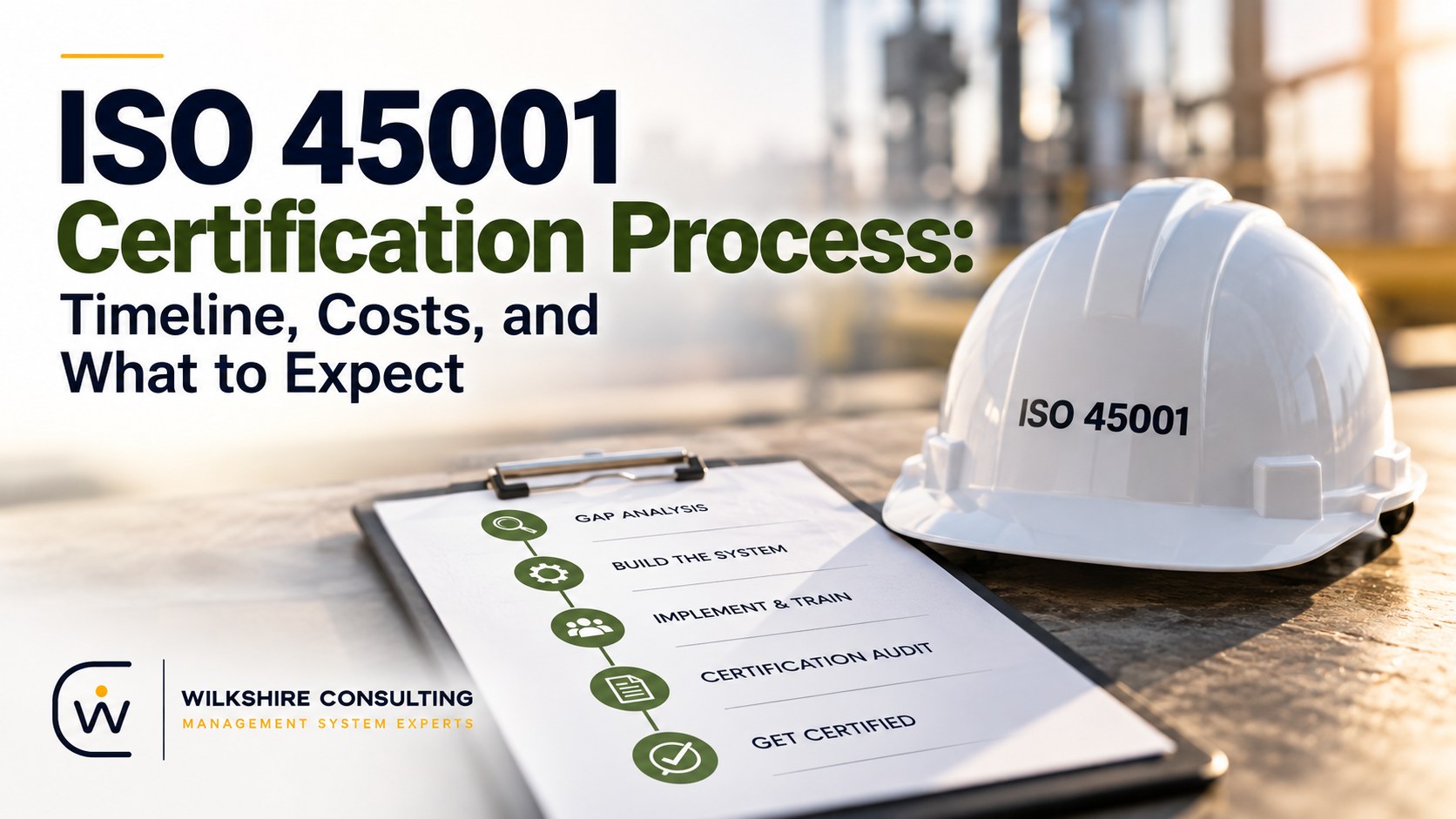
ISO 45001 certification is a structured, predictable process — gap analysis, build, implement, self-audit, external audit, certificate. The variability isn’t in the steps; it’s in how ready you are when you start. The organizations that move through it smoothly are the ones that understand the sequence going in and plan their time and budget around it, rather than treating the certification audit as the whole project when it’s really just the last step.
Quick answers
How long does ISO 45001 certification take? Typically three to six months for a single site starting from scratch, and longer, up to around twelve months, for multi-site, larger, or higher-hazard operations. It’s often faster if you’re adding it to an existing ISO 9001 or ISO 14001 system.
What does ISO 45001 certification cost? It depends mainly on your headcount, number of sites, and the complexity of your operation, which set the audit days and the amount of build work. The main components are certification body audit fees, optional consulting, training, and your own team’s time. Ask your certification body for a three-year quote.
What’s the difference between Stage 1 and Stage 2? Stage 1 reviews your documentation and readiness; Stage 2 assesses whether the system actually works in practice. You need to pass both to be certified.
How long is the certificate valid? Three years, with annual surveillance audits in years one and two and a full recertification audit in year three.
Can my consultant also certify me? No. The certification audit must be done by an independent accredited body — the party that builds your system can’t also be the party that certifies it.
Wondering what the ISO 45001 timeline and cost would look like for your specific operation? Learn more on our ISO 45001 consulting page, or book a free readiness call and we’ll map it out with you.