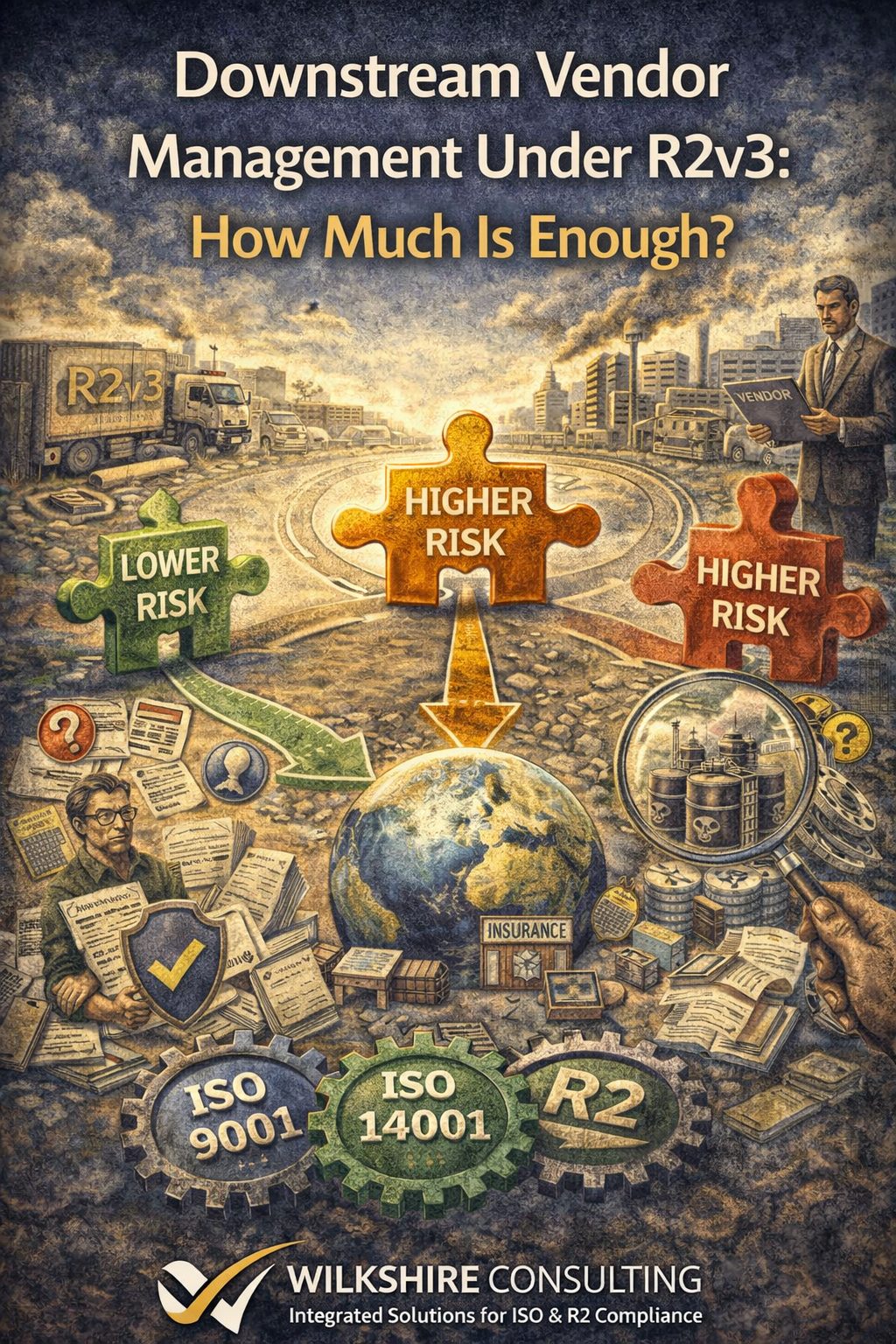
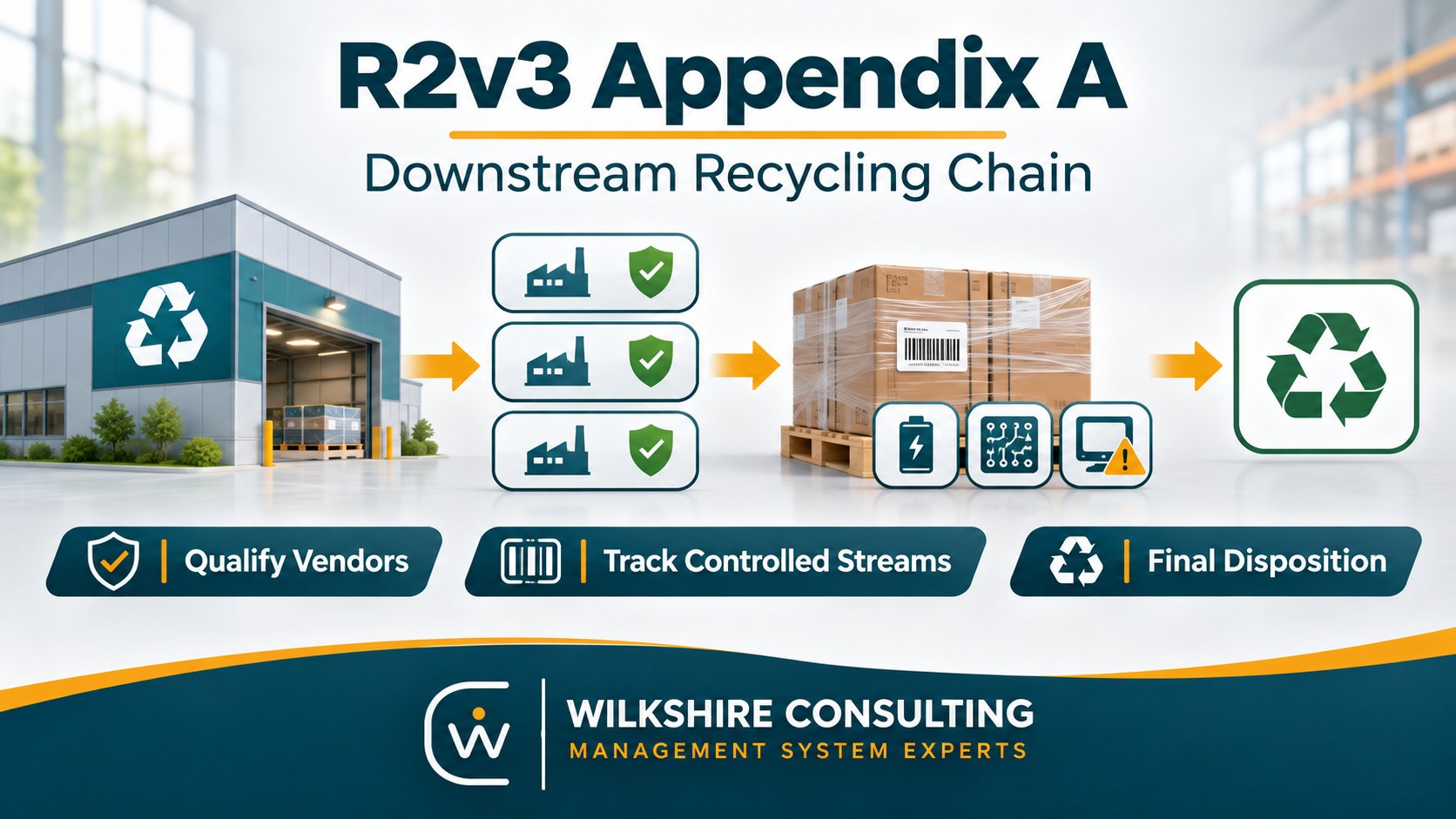
Appendix A of the R2v3 Standard covers the downstream recycling chain — the requirements for qualifying and managing every vendor your facility sends materials to after they leave your control. It’s the part of R2v3 that holds you accountable not just for what happens inside your four walls, but for where your materials go next, and the vendor after that.
This is one of the most important appendices for ITAD operations, returns processors, and any facility that doesn’t do every step of recycling in-house — which is nearly all of them.
The Idea Behind Appendix A
R2v3 is built on a simple but demanding principle: responsible recycling doesn’t end at your loading dock. If you ship materials to another facility for processing, you’re responsible for making sure that facility handles them responsibly too — and if they ship onward, that chain of accountability follows the material toward its final, legitimate end point.
Appendix A is how the standard enforces that. It applies to any R2 facility that uses another facility to process or manage R2 Controlled Streams, whether that downstream vendor is R2 certified or not. You don’t get to hand materials off and look away.
Two Key Definitions: Controlled Streams and Focus Materials
Appendix A revolves around two terms worth getting straight:
Controlled Streams are the material streams moving through your facility that have to be tracked and controlled because of the risk they carry — the equipment, components, and materials that contain, or may contain, Focus Materials or data. These are the streams R2v3 won’t let you lose sight of.
Focus Materials (FMs) are the specific higher-risk materials that warrant the closest control. Under R2v3, Focus Materials are equipment, materials, or components containing any of the following:
- Polychlorinated Biphenyls (PCBs)
- Mercury
- Cathode Ray Tubes (CRTs) and leaded glass
- Batteries
- Circuit boards
These materials are singled out because they carry the greatest environmental and health risk if mishandled — which is exactly why the standard tracks them so carefully through the recycling chain.
What Appendix A Requires
Once Controlled Streams enter your facility, they have to be sorted, categorized, and controlled through processing in a way that manages the risk those materials carry. And when any of that material is shipped to another facility, it has to be tracked. Specifically, Appendix A requires:
- Qualification of downstream vendors — you have to vet the facilities you send materials to, whether or not they’re R2 certified, to confirm they’ll handle the material responsibly.
- Tracking and traceability of Controlled Streams through the links of the chain, so the material’s path can be followed.
- Accountability down the chain — tracking is required for every R2 facility that isn’t the final processing point in the recycling chain. Tracking can stop at the first R2v3-certified downstream vendor, but only where you’ve registered your downstream chain with SERI.
The thread is traceability: at any point, you should be able to show where a Controlled Stream came from, where it went, and that every stop along the way was a qualified, responsible one.
How It Connects to Core Requirement 8 and Your Audit
Appendix A doesn’t stand alone. Core Requirement 8 (Focus Materials) calls for a documented Focus Material Management Plan, downstream vendor verification, and a flowchart of your downstream recycling chain — Appendix A is the process side of that same obligation.
It’s also where audits go wrong, because two of the deficiencies a certification body must record as major nonconformities sit right here: failing to identify a downstream vendor on the flowchart, and not performing due diligence effectively on shipments of Controlled Streams. The auditor has no discretion on those. In practice the flowchart gets matched against your actual shipping records, so if a vendor appears in your shipping data and not on the chart, that’s the finding. We cover the full set in our R2 Center overview of the findings that count as automatic majors.
Who Appendix A Doesn’t Apply To
Appendix A has clear limits, and they’re worth knowing so you don’t over-scope. It does not apply to:
- End-of-chain processors, such as a smelter, where the material has reached its final processing point and is no longer a Focus Material or R2 Controlled Stream.
- Downstream entities handling only sanitized, tested, and functioning products that are no longer subject to downstream control — in other words, working equipment destined for reuse, not Controlled Streams headed for recovery.
So the appendix is specifically about controlling the risk-bearing streams on their way through the recycling chain, not every product that ever leaves your building.
How Appendix A Fits With the Other Appendices
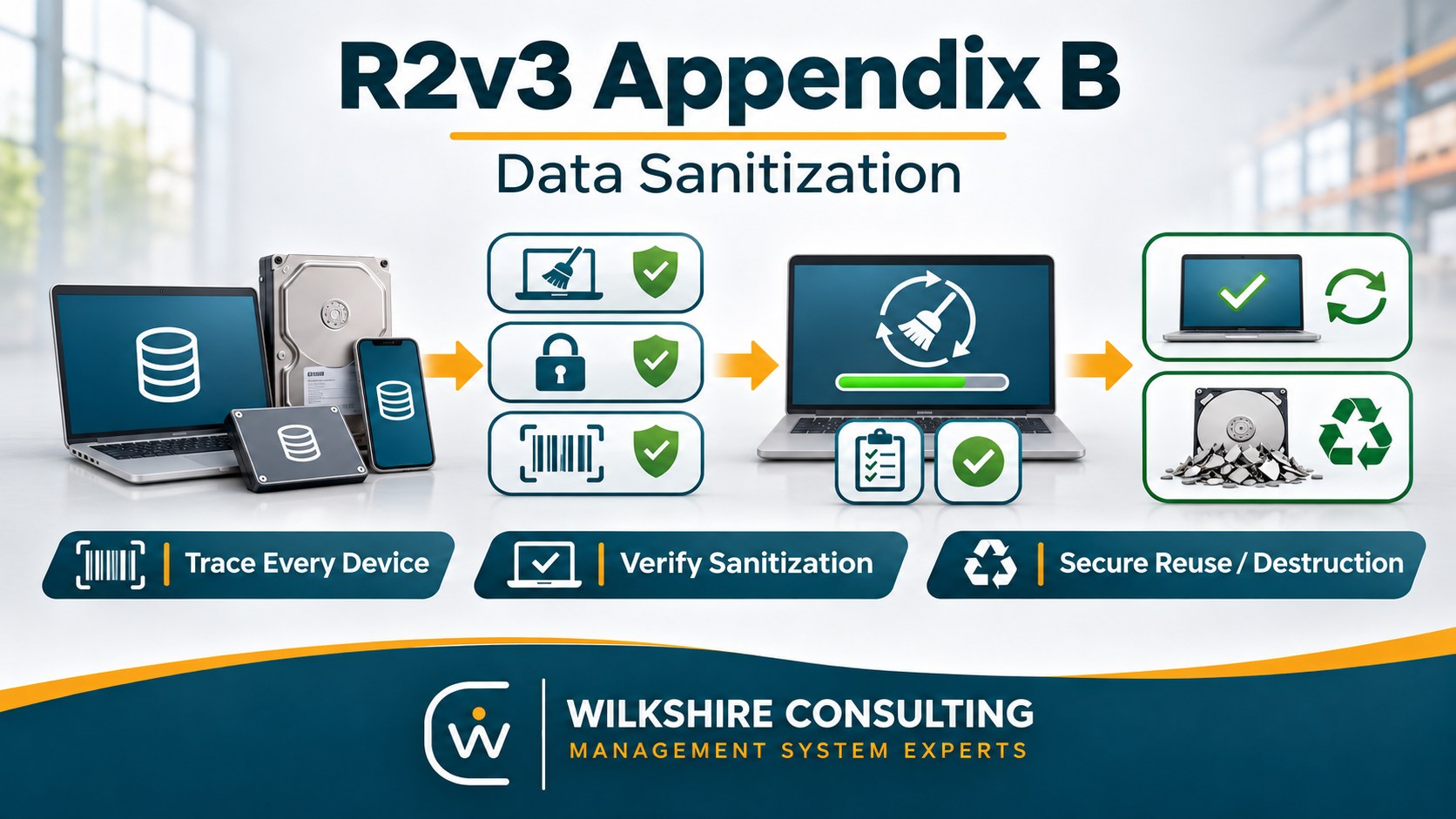
Appendix A is the connective tissue of R2v3. It links to Appendix E (Materials Recovery), because recovered streams leaving your facility for further processing have to be tracked through qualified vendors. It complements Appendix B (Data Sanitization), since data-bearing devices moving downstream carry their own control requirements. Most multi-process facilities hold Appendix A alongside whatever else they do, because very few operations are the entire recycling chain by themselves.
The Bottom Line
Appendix A is R2v3’s answer to the oldest problem in recycling: materials that get “recycled” by simply being shipped somewhere else and forgotten. It requires you to qualify your downstream vendors, track your Controlled Streams, and stay accountable for your Focus Materials as they move down the chain. For any facility that relies on downstream partners — which is almost every facility — it’s one of the most consequential parts of the standard.
Quick answers
What is the R2v3 downstream recycling chain? It’s the full chain of vendors your materials pass through after leaving your facility. Appendix A requires you to qualify those vendors and track Controlled Streams down the chain.
What are Focus Materials under R2v3? Equipment, materials, or components containing PCBs, mercury, CRTs/leaded glass, batteries, or circuit boards — the higher-risk materials R2v3 tracks most closely.
Does Appendix A apply if my downstream vendor isn’t R2 certified? Yes. Appendix A applies whether your downstream vendor is R2 certified or not — you’re responsible for qualifying and tracking either way.
Who is exempt from Appendix A? End-of-chain processors like smelters, and facilities handling only sanitized, tested, functioning products that are no longer Controlled Streams.
Not sure whether your downstream chain would hold up under an R2v3 audit? Score your facility with our free R2v3 readiness quiz, or book a free readiness call and we’ll help you map it.